
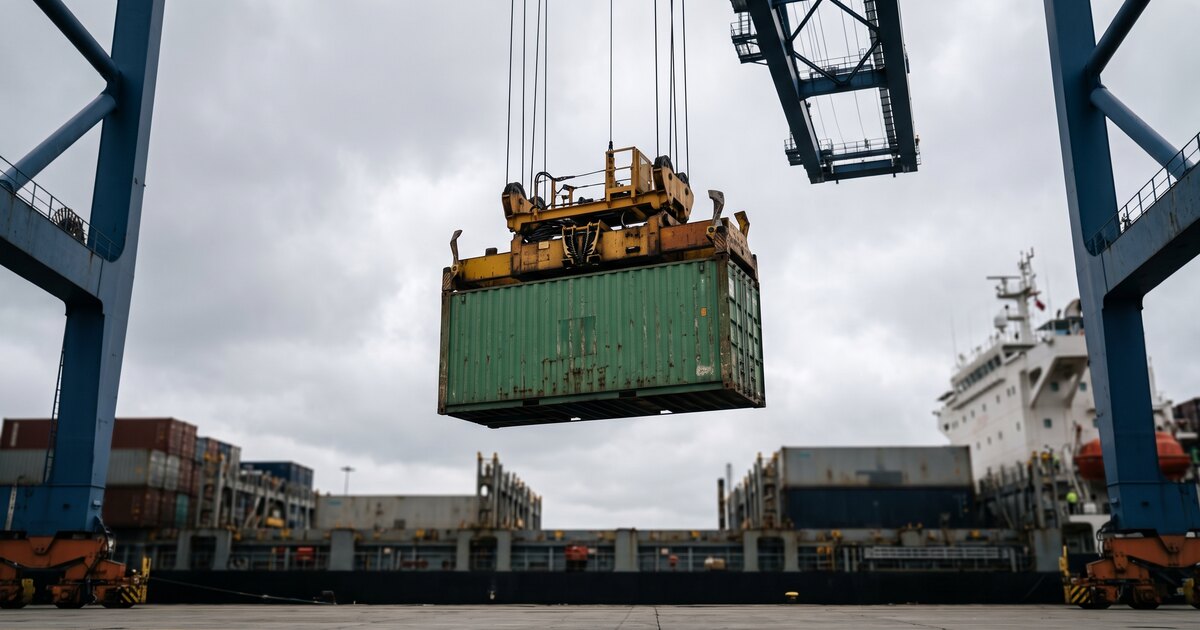
Somewhere between sixty and eighty percent of the world's container shipments are sold on FOB.
Almost none of them should be.
That is not a small technical quibble. It is the most widespread mistake in international trade, it has been pointed out by the body that writes these rules for more than a decade, and the world carries on regardless. Most of the time nothing goes wrong. When something does go wrong, it goes wrong in a gap that neither party knew existed.
This essay is the sea freight half. The first essay in this series explains what these three-letter codes are and what they are not. The second one covers air. This one covers ships, where all eleven codes can be used and four of them belong exclusively.
The eleven, split in two
Four are for sea and inland waterway only. They describe a handover that involves a vessel, so they cannot be used for air or road.
| Code | The handover moment |
|---|---|
| FAS | Alongside the ship, on the quay |
| FOB | On board the ship |
| CFR | On board the ship, but the seller pays freight to the destination port |
| CIF | As CFR, and the seller buys basic insurance |
Seven work for any transport, sea included: EXW, FCA, CPT, CIP, DAP, DPU and DDP.
So for a sea shipment you have all eleven available. The skill is knowing which four are genuinely for ships, and which of those four suits what you are actually shipping.
The container mistake, explained properly
FOB was written for a world of loose cargo. Sacks, drums, machinery, timber, steel. Goods went to the quay, a crane lifted them, and the moment they crossed onto the ship was a real, visible, provable moment. Everyone standing there could see it happen. Risk passing at that instant made complete sense.
Now picture a container.
Your supplier packs it at their factory on Monday. A truck takes it to the container terminal on Tuesday. It is handed over at the gate, and the terminal takes custody. It sits in the stack until Friday. On Friday a crane lifts it onto the ship.
Under FOB, the risk stays with the seller until Friday.
But the seller lost the container on Tuesday. They cannot see it, cannot inspect it, cannot move it, and cannot protect it. They are carrying risk on something they no longer control, sitting in a yard owned by a company they have no contract with.
Meanwhile the buyer, who arranged the ocean carriage and whose forwarder booked the slot, is not carrying the risk yet even though the goods are effectively in his supply chain.
If the container is damaged, dropped, flooded or stolen between Tuesday and Friday, you have a genuinely difficult argument, and it is difficult precisely because both parties assumed the handover happened at the gate.
The correct code is FCA. Free Carrier, at the container terminal. Risk passes at the handover, which is the moment everybody already treats as the handover in practice. The rules were even amended in 2020 to solve the one practical objection sellers had, by letting an FCA seller obtain an on-board bill of lading where the payment arrangement requires one.
The world still writes FOB. If you are the seller, this is worth pushing on, because you are the one carrying an invisible risk for three or four days on every shipment.
When each of the four sea terms is genuinely right
FAS, Free Alongside Ship. The seller delivers the goods to the quay next to the vessel. Used for bulk and project cargo: grain, ore, a transformer, a piece of plant that will be lifted by the ship's own gear or a shore crane. It is rare and it is specialised, and if you are shipping containers you almost certainly do not want it.
FOB, Free On Board. Genuinely correct for bulk and breakbulk, where loading onto the vessel is a real event with a real moment. Not correct for containers, whatever the rest of the world does.
CFR, Cost and Freight. The seller pays the ocean freight to the named destination port. Risk passes at loading in the origin port. No insurance is required from anybody, which means that unless somebody buys cover deliberately, the cargo crosses an ocean uninsured at the buyer's risk.
CIF, Cost Insurance and Freight. As CFR, plus the seller must insure. The cover required is the minimum level, not the wide all-risks style cover most buyers imagine. If the cargo deserves better, say so in the contract or buy your own.
CFR and CIF are correct for bulk and breakbulk for the same reason as FOB. For containers, the any-mode equivalents are CPT and CIP, and CIP carries the wider insurance.
The seven any-mode terms at a seaport
EXW the seller's factory. You collect, you do everything, including their country's export clearance, which as a foreign buyer you often cannot legally do.
FCA the container terminal or the seller's premises. The honest container term. Name the place precisely.
CPT to the destination port or your city. Seller pays the carriage, risk passes at the first carrier.
CIP to the destination port or your city. As CPT with proper insurance. This is what a container buyer usually means when they ask for CIF.
DAP your address. Seller delivers to your door. You clear customs and pay duty.
DPU your address, unloaded. The only term where the seller unloads at your end.
DDP your address, duty paid. Seller pays everything including your import duty. Heavy, and often not legally possible for a foreign seller.
The traps that belong specifically to sea
Terminal handling charged twice. This is the classic one. Terminal handling charges exist at both ends of the journey, and they are frequently written into both the seller's freight rate and the buyer's clearing bill. Under CFR or CIF the seller's freight is supposed to include the destination terminal handling, but shipping lines often bill it locally to whoever is collecting the container.
The result is that the buyer pays a charge the seller already included in the price. It is not fraud. It is two contracts that overlap.
The fix is one line in the contract: state which side pays the terminal handling at each end, by name.
Under CFR and CIF, you are at risk from day one. The seller has paid the freight, so the buyer relaxes. But if the vessel has a problem in mid-ocean, that is the buyer's cargo and the buyer's loss. The seller's obligation was to pay for transport and, under CIF, to buy a minimum insurance. It was never to deliver safely.
Demurrage and detention land on whoever is clearing. These are the daily charges when a container sits too long at the port, or stays out too long after leaving it. They are, on the shipments that lose money, usually bigger than the customs duty.
Under CIF and CFR, the seller booked the shipping and chose the line. The buyer clears the cargo and therefore eats every day of delay, on free-time conditions he did not negotiate and often has never seen.
That is a real imbalance and it is worth acting on. Ask your supplier, at booking, how many free days the line has given and on what terms. It is a two-line email and almost nobody sends it. If you want to see what those days cost in money, the Demurrage and Storage Clock on this site works it out from the operators' published tariffs.
The named port is not precise enough. A large city can have several terminals with different tariffs, different free time and different congestion. "CIF Lagos" does not tell you whether the box is coming to one terminal or another, and that choice changes your storage bill and your haulage.
Name the terminal where you can, or at least ask which one the booking is for.
LCL changes the arithmetic. In a shared container, the destination charges are billed per shipment and can be surprisingly large relative to the freight. A term that stops at the port leaves a small importer exposed to a destination bill that can approach the cost of the sea freight itself. Ask for those destination charges in writing before you accept a port-to-port term.
Which one should you use
| What you are shipping | Buyer wants | Sensible term |
|---|---|---|
| Full container | Cheapest, own forwarder | FCA at the origin terminal |
| Full container | Seller arranges, real insurance | CIP to your port or city |
| Full container | Delivery to your door, you clear | DAP your address |
| Shared container | Predictable total | DAP, or a port term with destination charges quoted in writing |
| Bulk or breakbulk | Seller loads, you carry | FOB the load port |
| Bulk or breakbulk | Seller pays the voyage | CFR or CIF the discharge port |
| Project cargo lifted at the quay | Precise handover | FAS the load port |
If you are the seller, quote FCA for containers. It ends your responsibility at a clean, provable moment, it stops you carrying invisible risk in a yard you cannot see, and it is honest about what your price covers.
If you are the buyer and you want it arranged for you, ask for CIP, not CIF. Same convenience, much better insurance, and it is the correct family of term for a container.
The habit
Write the code, name the place as precisely as you can, and add one sentence saying what the price does not cover.
Term: CIP Apapa, Lagos. Our price covers the goods, export clearance, ocean freight and all-risks marine insurance to Apapa. It does not cover terminal handling at Apapa, import duty, taxes, clearing or delivery, which are payable by you.
Three lines. It ends the argument before it starts, and clients notice who bothers to explain.
Where to check any of it
The Quotation Builder lists every trade term in plain English, works out chargeable weight correctly for full and shared containers, and warns you when the term you picked contradicts how you priced the duty.
The Demurrage and Storage Clock prices the days, which is where sea shipments actually lose money.
And the Landed Cost Calculator shows what a port-to-port price becomes by the time the goods are in your warehouse, which is the number the term never tells you.
The short version
All eleven terms work at sea. Four belong to ships alone, and three of those four assume a loading moment that containers do not really have.
Use FCA for containers. Use FOB for bulk. Ask for CIP, not CIF, when you want it arranged and insured. And whatever you agree, find out how many free days you have before the container lands, because that is the number that decides whether the shipment made money.