
There is a moment in every long career when you realise something uncomfortable: you have stopped learning and started remembering.
You still answer questions quickly. Clients still nod. But the answers come from a store of things you picked up years ago, and you have not checked whether any of them are still true. In an industry where a government charge can change in a budget speech and a shipping line can rewrite its terms in a circular, remembering is not the same as knowing.
I hit that moment about a year ago, and went back to studying my own trade as if I had just joined it.
It was the second time I have had to do that. The first time, I did not choose it either. Marketing forced me.
I did not arrive in logistics as a logistics person
I came into freight as a digital marketer.
My job was to build the brand. The identity, the graphics, the website, the analytics, the content, the search rankings, the campaigns. Then the harder half: business to business marketing, because in freight the customer is not a shopper. It is a company, and inside that company a particular person with a particular problem.
So I did what a competent marketer does. I built the website properly. I wrote and published, and the articles started ranking. I ran paid search, tuned the keywords, balanced digital spend against the traditional channels that still work in our market, designed a funnel from first click to enquiry, and optimised it.
For more than a year, it barely worked.
Not "no traffic". Traffic was fine, rankings improved, the brand looked better than the competition. What did not arrive was business. Enquiries came in and went nowhere. Leads looked like leads and behaved like tyre-kickers.
That failure was the most useful thing that happened to me in this industry.
What was actually wrong
I was marketing a service I did not understand, to a buyer I had not properly defined.
I could describe freight forwarding in the words on our own brochure. I could not have told you what actually keeps an importer awake. I did not know what happens on day forty of a container sitting at a terminal. I could not have explained to a buyer why one clearance costs twice another. I was writing content about "seamless global logistics solutions" for people whose real question was much smaller and much sharper: if I give you this shipment, will it arrive without hurting me?
In business to business freight, nobody buys transport. They buy the removal of a specific fear. And the fear is different depending on who is reading:
The procurement officer fears being blamed for a delay on a production line. The finance controller fears a bill that arrives bigger than the quotation. The factory manager fears the plant standing still. The small trader fears the money simply disappearing. Same service, four completely different anxieties, and I had been writing one message for all of them.
You cannot write that message from a marketing textbook. You have to learn the trade.
So I learned the trade, in order to sell it
I stopped writing for a while and started asking. What are the lanes we actually serve, and why does one cost so much more than another? What goes wrong most often, and at which stage? What does a client mean when they say a competitor was "cheaper"? What does the paperwork actually do?
I sat with the operations side and learned their vocabulary properly, not enough to nod along, enough to explain it. I learned what a delay costs per day and who charges it. I learned the difference between what a quotation promises and what a shipment delivers.
Then I rebuilt everything on top of that understanding.
The content stopped being about us and started answering the question a real buyer types at 11pm. The campaigns stopped chasing everyone and went after the specific person with the specific fear. The message became concrete: not "global solutions", but the thing that would actually happen to their cargo, and what it would cost.
And it started working. Not slowly. The funnel began capturing demand that already existed instead of shouting into the market hoping to create some. Enquiries turned into quotations, quotations turned into jobs, and the jobs turned into accounts that came back. Over the years that followed, that work brought in well past a million dollars in client revenue, a community built from zero, awards, and eventually a promotion out of pure marketing into the commercial and performance side of the business.
The lesson underneath it has never left me: you cannot market what you do not understand, and the fastest way to become good at selling something is to become genuinely good at the thing itself.
The second time, nobody forced me
A decade later, I was on the other side of that equation. I had moved through overseas coordination, customer service, quotations, tenders, and finally into business performance, which is the job of looking across a whole company and asking whether the machine is actually making money.
And I noticed I had started remembering again. Answering from a store, not from knowledge.
So I did the same thing deliberately, but deeper, and this time on the operational and commercial side rather than the marketing side. I started with paperwork.
The reason is simple. A course teaches you the version of the industry that is written down. Documents show you the version that actually happened. Between those two versions sits everything interesting.
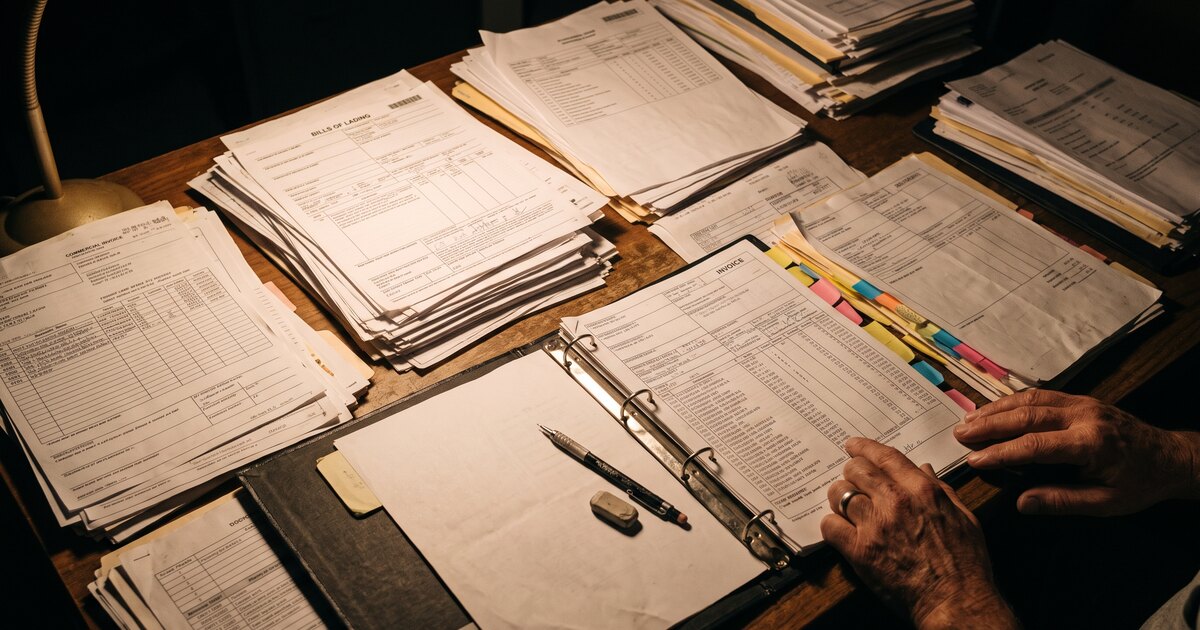
I collected completed job files. Not live ones, where everyone is busy and defensive, but closed ones, where the shipment has landed, the invoices are settled and nobody has anything to protect. A closed file is a confession. It tells you exactly what was promised, what was done, what it cost and what was left over.
The method, in case you want to copy it
Five rules, and none of them need permission or a budget.
One: read the whole file, not the interesting part. The instinct is to jump to the invoice. Resist it. Start at the enquiry, then the quotation, then the transport document, then the customs entry, then the supplier bills, then the final invoice. The story only makes sense in order, because most problems are created early and only become visible late.
Two: reconcile, do not just read. Put the quotation next to the invoice and ask what changed. Put the supplier's bill next to the supplier's own quote and ask the same. This is not about catching anyone out. It is the only way to see where the difference between the expected result and the actual result comes from.
Three: keep a list of every word you cannot explain to a child. Mine was long and slightly humiliating. I had used terms for years that I could deploy in a sentence but not define properly. Every one of those words was a gap I had been walking past.
Four: ask who touched it, and what that touch cost. A shipment passes through many hands: supplier, forwarder, shipping line, terminal, customs, regulator, transporter, bank. Each adds a cost and a delay. Once you can name all of them for a single file, you understand the trade better than most people who have worked in it for years, because most of us only ever see our own hands.
Five: write it down for someone else. This is the real exam.
What the second relearning taught me
The gap between what a job earns and what it keeps is bigger than anyone admits. A file can look healthy on the invoice and be thin once every cost is counted: money fronted on the client's behalf and the weeks it sits out there, bank charges on foreign payments, small charges absorbed rather than billed because nobody wanted an awkward conversation. None of these are dramatic. Together they decide whether a business is profitable.
Most documents are ignored until the day they matter enormously. Nobody reads a certificate carefully until a container is at the port and an officer is asking for it. By then it is often too late to obtain one.
Procedure and practice are two different animals. Companies write procedures, get certified, file the manual, then work from habit. It is rarely rebellion. Usually the procedure was written for a business that has since changed shape, and nobody revised it.
The vocabulary is the barrier, and it is doing real damage. This is the finding that decided what I do now. Every trader I have met who was badly hurt by a shipment was hurt in a place they had no words for. They did not know what a code number had to do with their tax rate. They did not know a clock started ticking the day their container was discharged. They were not foolish. Nobody had ever explained it in language they could use.
That is the same wall I hit as a marketer, seen from the other side. Back then it stopped me selling. Now I can see it stopping people trading.
The test that matters
Writing it down for someone else is where learning gets real.
You can read a file and feel you understand it. Then you try to explain it to somebody outside the industry, and discover the understanding was thinner than it felt. You reach for a technical word because you cannot describe the thing itself. That reach is the signal: you know the label, not the mechanism.
So I set a rule that now governs everything I publish. If I cannot explain it to a teenager, I do not understand it well enough to charge anyone for it.
It is slow and occasionally painful. It is also the most useful professional discipline I have adopted, and it makes me better at the commercial job too, because the person paying the bill wants exactly the same plain explanation the teenager wants. They are just too senior to admit it.
Where this leads
I am not going to pretend any of this was a grand plan. The first round was a marketer trying to stop failing. The second was a manager who noticed he had gone stale.
What the two produced together is the thing on this site: plain-English explanations of how goods really move, checklists of what each kind of shipment needs, and free tools built from real computation rather than rules of thumb.
If you are experienced and this essay is making you slightly uncomfortable, follow the discomfort. Pick one closed file. Read it from the first email to the last payment. Write down every word you cannot explain simply.
You will not enjoy the first hour. You will not work the same way afterwards.