
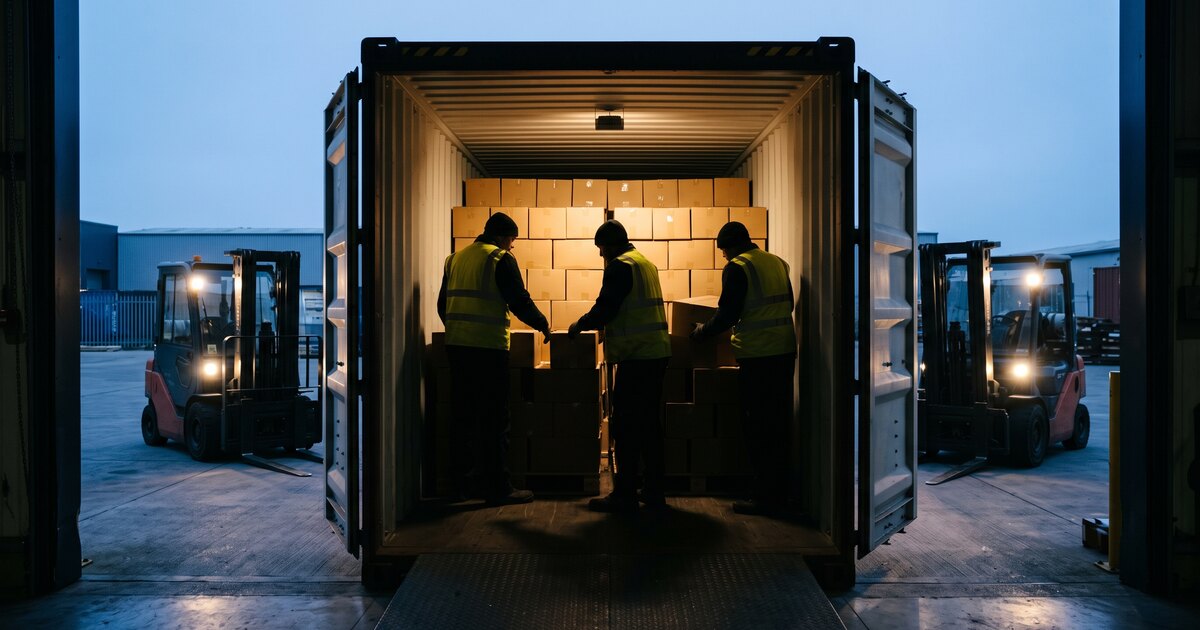
Here is something most importers do not know about the company they hired.
When you give a shipment to a freight forwarder in your own country, they usually do not own a ship, a plane, a truck or a warehouse. And for the half of the journey that happens abroad, they are not even there. They hand your cargo to a company you have never heard of, in a country you may never visit, run by people you will never meet.
That company collects your goods from your supplier, checks the paperwork, books the space, and puts your shipment on the vessel. If they do it well, you never learn their name. If they do it badly, you spend the next six weeks paying for it.
I have spent a lot of my career on the other side of that relationship, coordinating with overseas partners in Europe, Asia, the Middle East, the Americas and elsewhere in Africa. Sending them cargo, receiving cargo from them, arguing with them about charges, and occasionally rescuing shipments that had gone wrong before they ever reached my country.
This is what that taught me, and most of it is useful whether you are a forwarder or somebody hiring one.
First, how the system actually works
Freight forwarding runs on agent networks. A forwarder in Lagos joins a network, a forwarder in Shanghai joins the same network, and the network's job is to be the reason they trust each other enough to hand over cargo and money.
That trust is the entire product. Nobody in this business signs a fresh contract for every shipment. A forwarder in one country takes on an obligation to a client, then relies on a company eight thousand kilometres away to fulfil half of it, usually on the strength of an email and a shared membership.
Once you see that, a lot of the industry's odd behaviour makes sense. Why forwarders are so careful about who they work with. Why a bad experience gets remembered for years. Why the good partners are protected and rarely mentioned.
It also explains the risk you are actually taking when you hire one. You are not just buying their competence. You are buying their judgment about other people.
The four things that separate a good partner from an expensive one
After enough shipments in both directions, the differences stop being subtle.
One: a good partner tells you the bad news early.
Every shipment develops problems. The vessel rolls to the next sailing. The supplier is not ready. A document has the wrong weight on it. None of that is unusual and none of it is the test.
The test is when you find out.
A good partner tells you on the day they learn it, before you have promised anything to your client. A weak one goes quiet, hopes it resolves itself, and tells you when it is already a crisis and you have already given a date to somebody who is now angry with you.
The information was the same. The value of it collapsed with time.
Two: a good partner quotes what it will actually cost.
There is a style of quoting, common everywhere, where the headline number is attractive and the real number arrives later in pieces. A handling charge that was not mentioned. A document fee. A drayage charge that appears on the invoice and was never in the quote.
I have reconciled enough partner quotes against partner invoices to know how ordinary this is. It is rarely dishonest. It is usually a quote written quickly, from a template, by somebody who did not check what was actually included.
But the effect on you is identical either way: you quoted your own client from a number that was not real, and the difference comes out of your margin, because you cannot go back and re-price a job you already won.
Three: a good partner knows what your country needs.
This is where the largest failures happen, and they happen at origin.
Many countries require certificates that can only be issued in the exporting country, before the goods load. Standards certificates. Product registrations. Plant and animal certificates. Once the vessel sails, they cannot be created. Not with a relationship, not with a payment, not at all.
A partner who understands your market checks that before loading. A partner who does not will ship the cargo perfectly, on time, with immaculate documents, straight into a penalty that you will spend two months and a lot of money resolving.
I have watched this happen more than once. The shipment was not delayed. The cargo was not damaged. Everything went exactly to plan, and the plan was wrong from the first week.
Four: a good partner answers when the answer is embarrassing.
The single most reliable signal I know is how a partner behaves when something is their fault.
The good ones reply the same day, say what happened, and propose the fix. The rest go quiet exactly when you need them most, and the quiet is worse than the mistake, because it stops you from doing the one thing that would have limited the damage: knowing.
What I got wrong, for a long time
I want to be honest about my own side of this, because I do not think I was unusual.
For years I judged partners mainly on price. If two agents quoted the same lane and one was cheaper, that was the one I would push for. It felt like doing my job well.
It took reading closed files, properly, from the first email to the last payment, to see how badly that was measured.
The cheaper partner was often cheaper because something was missing from the quote. Or because they were slower at documents, and slow documents at destination cost more per day than the entire difference in their fee. Or because they needed three times as much chasing, which is a real cost that never appears anywhere, since nobody bills their own hours.
The expensive partner who got it right first time was frequently the cheaper one by the time the file closed. I simply had no way of seeing it, because nobody measured the file as a whole. We measured the rate.
That is the single most useful thing I have learned in this industry, and it applies far beyond freight: you get what you measure, and most companies measure the part that is easy to see.
What this means if you are hiring a forwarder
You cannot audit their overseas partners. But you can ask three questions, and how they answer tells you a lot.
"Who is handling this at the other end, and how long have you worked with them?" You are not checking the name. You are checking whether the question is comfortable. A forwarder who works with people they trust answers it easily.
"What is not included in this price?" The best answer is a specific list. The worst answer is that everything is included, because nothing ever is.
"What certificates does this product need before it ships, and who is getting them?" If the answer is vague, or if it arrives after a pause and a phone call, you have learned something important while it is still cheap to learn.
And if you are a forwarder
Three things, from the other side.
Reconcile the partner's invoice against the partner's own quote, on every file. Not occasionally. The gap between what a partner quoted you and what they billed you is one of the most consistent quiet losses in the business, and it is invisible unless somebody deliberately looks.
Write down what happened. Every network has partners who are excellent and partners who are not, and that knowledge usually lives in one person's memory. When they leave, it leaves. A one-line note after every file is enough.
Be the partner you want. It sounds soft. It is not. Reputation in this business travels through a network of a few thousand companies who all talk to each other, and it travels faster than any marketing you will ever buy. The forwarders who get the best inbound work are not the cheapest ones. They are the ones other forwarders are willing to vouch for.
The part I did not expect
I came into this expecting the international side of logistics to be about systems, rates and regulations.
It is mostly about people you will never meet in person, choosing whether to be careful on your behalf, in a country where nobody is watching them and nothing forces them to be.
The whole global trading system, the one that put the phone in your hand and the food on your table, runs on that. It is a strange and slightly wonderful thing, and it works far more often than it should.