
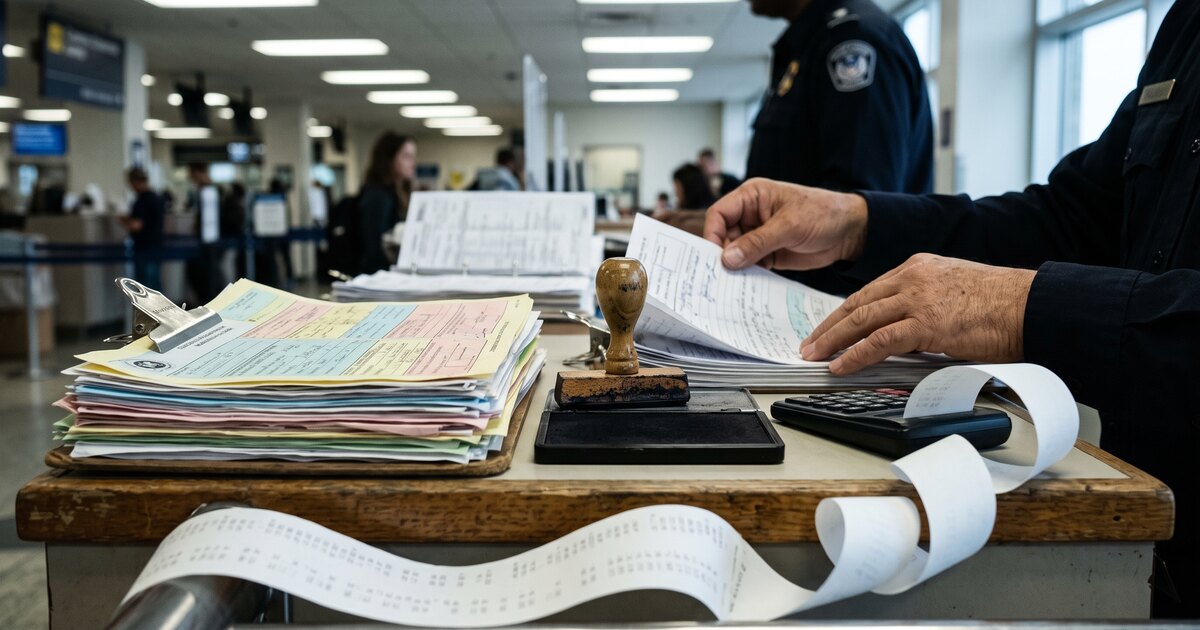
There is a particular silence that happens when an importer sees their customs assessment for the first time.
They budgeted for the duty. Somebody told them the rate, they multiplied it by the value of the goods, and they wrote the number down. Then the real bill arrives and it is not that number. It is often close to twice that number, and nobody warned them.
It is not a mistake and it is not corruption. The bill is bigger because it was never one charge. It is six or seven separate charges stacked on top of each other, and one of them is calculated on top of all the others.
Almost nobody explains this. So here it is, in order, in plain words.
First, the value customs actually taxes
Before any percentage is applied to anything, customs decides what your shipment is worth. This is the part people get wrong first, because they assume it is the price on the supplier's invoice.
It is not. Customs adds three things together:
The price of the goods. What you paid your supplier, before any transport.
The shipping cost. What it cost to bring the goods to the country.
The insurance. What it cost to cover them on the journey. If you did not insure them, customs usually assumes a small percentage anyway.
Those three added together are called the CIF value (Cost, Insurance and Freight). Almost every charge below is a percentage of that number, not of your invoice.
So the first surprise is arithmetic. If your goods cost 30,000 dollars and the freight and insurance came to 5,000, you are not being taxed on 30,000. You are being taxed on 35,000. On a shipment with expensive freight, that difference alone can be significant, and it is why a cheap supplier a long way away is not always cheaper than an expensive one nearby.
Then the charges, one at a time
Import duty. The main tax, and the only one most people know about. The rate comes from your product's HS code (Harmonised System code, the number customs everywhere use to identify goods), and it can be anything from zero to thirty five percent depending on what you are bringing in.
This is worth stopping on. The duty rate is attached to the code, not to your description of the goods. Two believable codes for the same item can sit in completely different bands. Getting that code right before you buy is the single highest-value five minutes in the whole process.
A customs service levy. A percentage charged to fund the customs service itself: the people, the scanners, the systems and the offices that process your declaration. In effect you are paying for the service that clears your cargo, and it is charged on the goods value rather than the CIF total.
A port surcharge. A percentage of the duty, set aside to build and maintain the ports, quays, roads and equipment your cargo has just used. Note that this one is a percentage of the duty, not of the goods. So a high duty rate makes this charge bigger too.
A regional trade levy. A small percentage that funds the arrangement letting goods made inside the West African region move between member countries without duty. Goods coming from outside the region contribute to running it.
Extra levies on certain products. Rice, sugar, cement, textiles, tobacco and a handful of others carry an additional levy on top of the ordinary duty. These exist to make local production worth doing. You can debate whether they work. They are policy, made in public, not a fee invented at the gate.
Excise duty. Applied mainly to tobacco and alcohol, in most countries, to make them more expensive on purpose.
And then the one that catches everybody
VAT.
Value Added Tax is the ordinary tax on spending, the same one you pay in a shop. It is collected at the port instead of at the till, so that imported goods and locally made goods carry the same tax. That part is fair and most people accept it.
Here is the part that is not obvious.
VAT is not charged on your goods. It is charged on the goods plus the freight plus the insurance plus the duty plus the surcharge plus every levy above.
Tax on top of tax.
That single rule is the biggest reason a customs bill lands larger than expected. It also means a high duty rate hurts you twice: once directly, and again because the VAT is calculated on a base that now includes the duty.
What it looks like when you add it up
Take a container of goods worth 30,000 dollars, with 4,000 dollars of freight and a little insurance. Say the duty rate is ten percent.
Most people budget 3,000 dollars, being ten percent of the goods.
What actually happens is that the duty is charged on the CIF value rather than the goods, then the customs levy is added, then the surcharge on the duty, then the regional levy, and then VAT is charged on the whole accumulated total.
The realistic figure lands somewhere close to thirty percent of what you paid your supplier, not ten.
That is the gap. Not corruption, not a mistake, just six charges where the importer had planned for one.
And on a product in a higher duty band it gets worse quickly, because the duty rises, the surcharge on the duty rises with it, and the VAT base rises to include both.
The three decisions that move this number
Once you can see the structure, you can see where the leverage is. There are three places, and none of them are at the port.
The code, chosen before you buy. This is the biggest single lever there is. Ask your supplier for the six-digit code on their export documents. Check it against the tariff. For anything large, get a licensed agent to classify it in writing before you pay for the goods. A code decided in an argument at the port, under storage charges, is decided badly.
The declared freight, which must be the real one. Write the actual amount on your transport document. If customs later finds the true figure was higher, they issue an additional bill, and the fees on that can wipe out whatever you thought you were saving.
Whether a legal relief applies to you. Real exemptions exist, written into law, for particular projects, institutions and categories of goods. They are approved in advance, they need an application and supporting letters, and they take weeks. An exemption you have applied for is not an exemption you hold. But if one genuinely applies to you and you did not ask, that is money left behind for no reason.
Why I built a calculator for this
I got tired of explaining it one conversation at a time.
Every trader I have met who was badly hurt by a shipment was hurt in a place they had no words for. They did not know a code number decided their tax rate. They did not know VAT was charged on top of the duty. They were not foolish. Nobody had ever explained it in language they could use, and the official tariff, while genuinely public, is a spreadsheet of tens of thousands of lines that assumes you already know what you are looking for.
So the Customs Duty Calculator on this site does the explaining.
You type what the item is in your own words. Fridge. Rice. Solar panel. Generator. It searches the country's actual tariff schedule, shows you the codes that match, and tells you the rate attached to each one. Then it calculates every charge above, in order, and explains what each one is for while it does it.
It also does two things I have not seen a free tool do.
It tells you which government agencies your product needs, and crucially when. Standards certificates, product registrations and plant certificates are almost all issued in the exporting country before the goods load. They cannot be obtained afterwards at any price. Finding that out from a web page today is better than finding it out from an officer in ten weeks.
And it lets you compare two codes side by side, so you can see for yourself what a classification decision is worth on your shipment. Usually it is worth more than the entire freight.
Nothing you type into it is sent anywhere. It runs in your browser, it is free, and it needs no sign-up.
The thing I would tell every importer
You are not being cheated. You are being charged six times by four different organisations, in an order nobody has ever laid out for you.
Once you can see the order, the whole thing becomes plannable. You stop being surprised, you start pricing correctly, and you discover that the difference between traders who make money on imports and traders who do not is almost never the negotiation with the supplier.
It is whether they knew what the bill would be before they agreed to the deal.